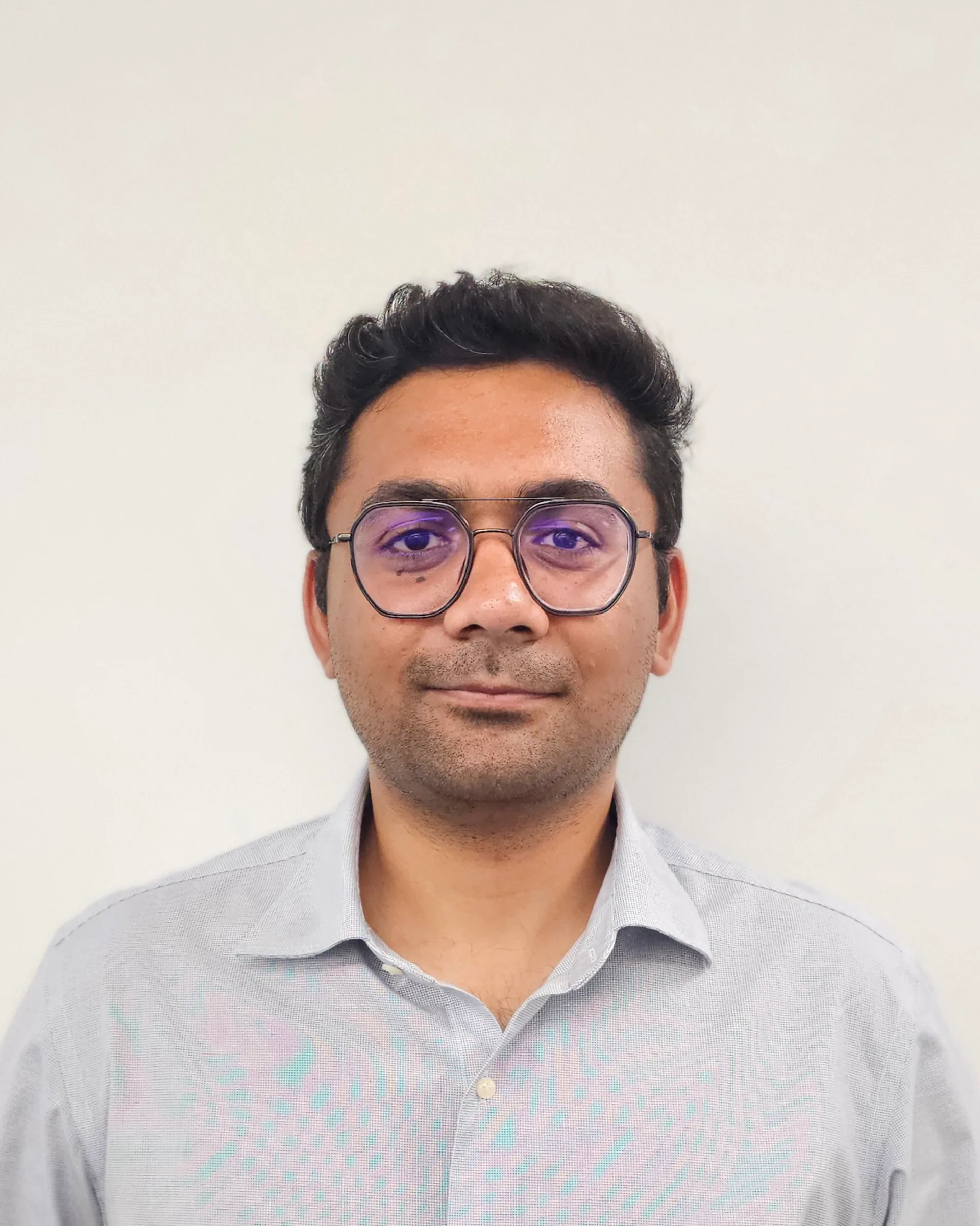
Hariprashad Ravikumar
I turn large-scale physics simulations into software that engineers actually use. At Western Digital I derived closed-form models for heat-assisted magnetic recording from first principles and shipped a full-stack enterprise physics simulator that the team now runs across sites in the US and Japan.
My PhD at New Mexico State University applies GPU-accelerated HPC and machine learning to lattice QCD with 30,000+ observables, CUDA C++ pipelines, and symbolic regression that recovers analytical structure from noisy Monte Carlo data using HPC (High Performance Computing).
Experience timeline


Western Digital · San Jose, CA · Summer 2026
I built a full-stack enterprise HAMR simulator now used daily by 40+ senior R&D engineers and subject-matter experts across WD's US and Japan sites.
Over summer 2026 I derived closed-form analytical models for grain magnetization dynamics in Heat-Assisted Magnetic Recording from first principles, predicting adjacent-track erasure (ATI & xTI) without costly hardware experiments.
I shipped a production Dash/Plotly simulation platform packaged as a modular Python library, deployed on Kubernetes with Jenkins CI/CD and adopted by sputtering and media engineering teams.
40+
R&D experts
2
R&D projects shipped
1
hackathon award
Featured projects
All projects →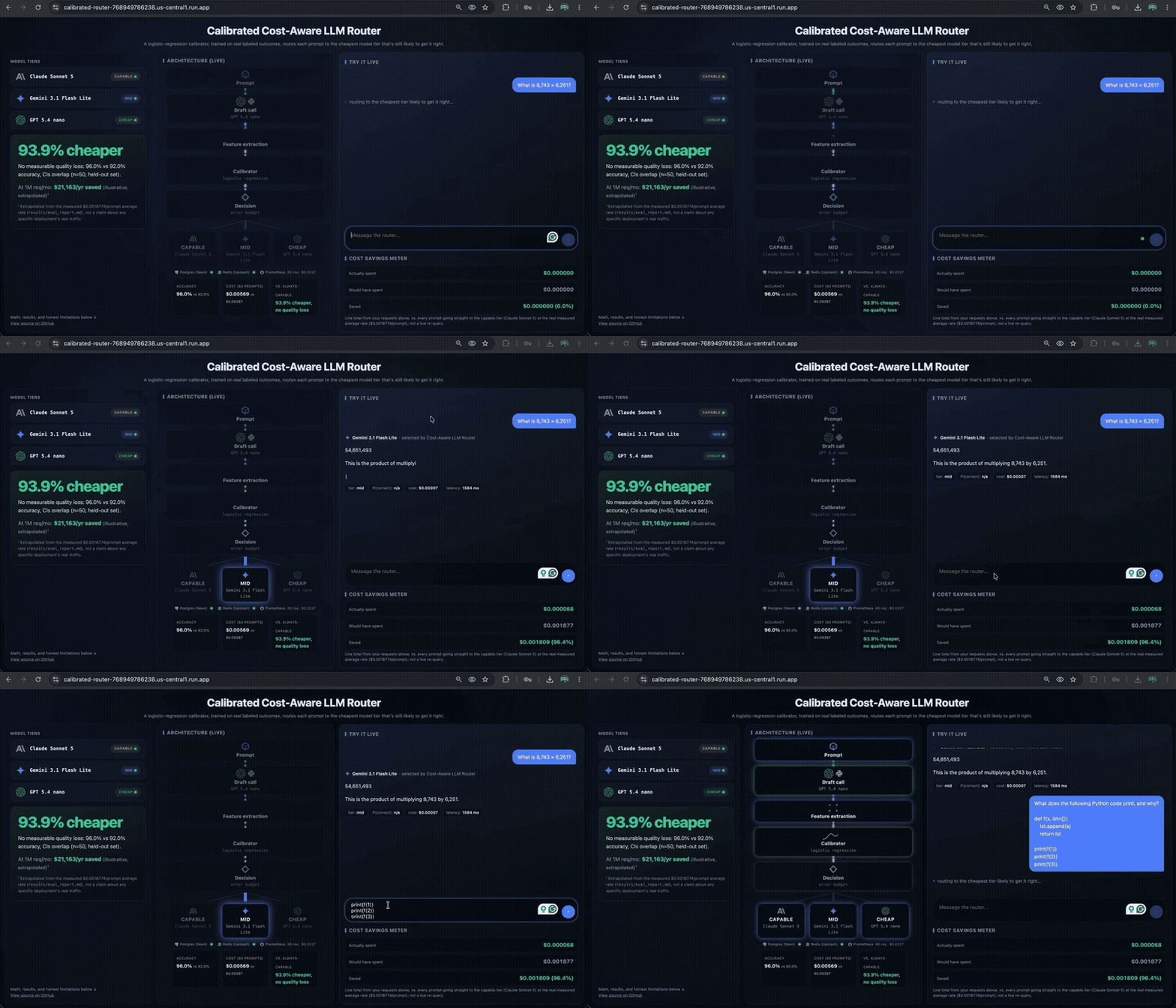
Cost-Aware Multi-Agent LLM Router
Calibrated router that cuts LLM API cost 93.9% at accuracy parity (96.0% vs 92.0%, overlapping CIs) versus always calling the most capable model.
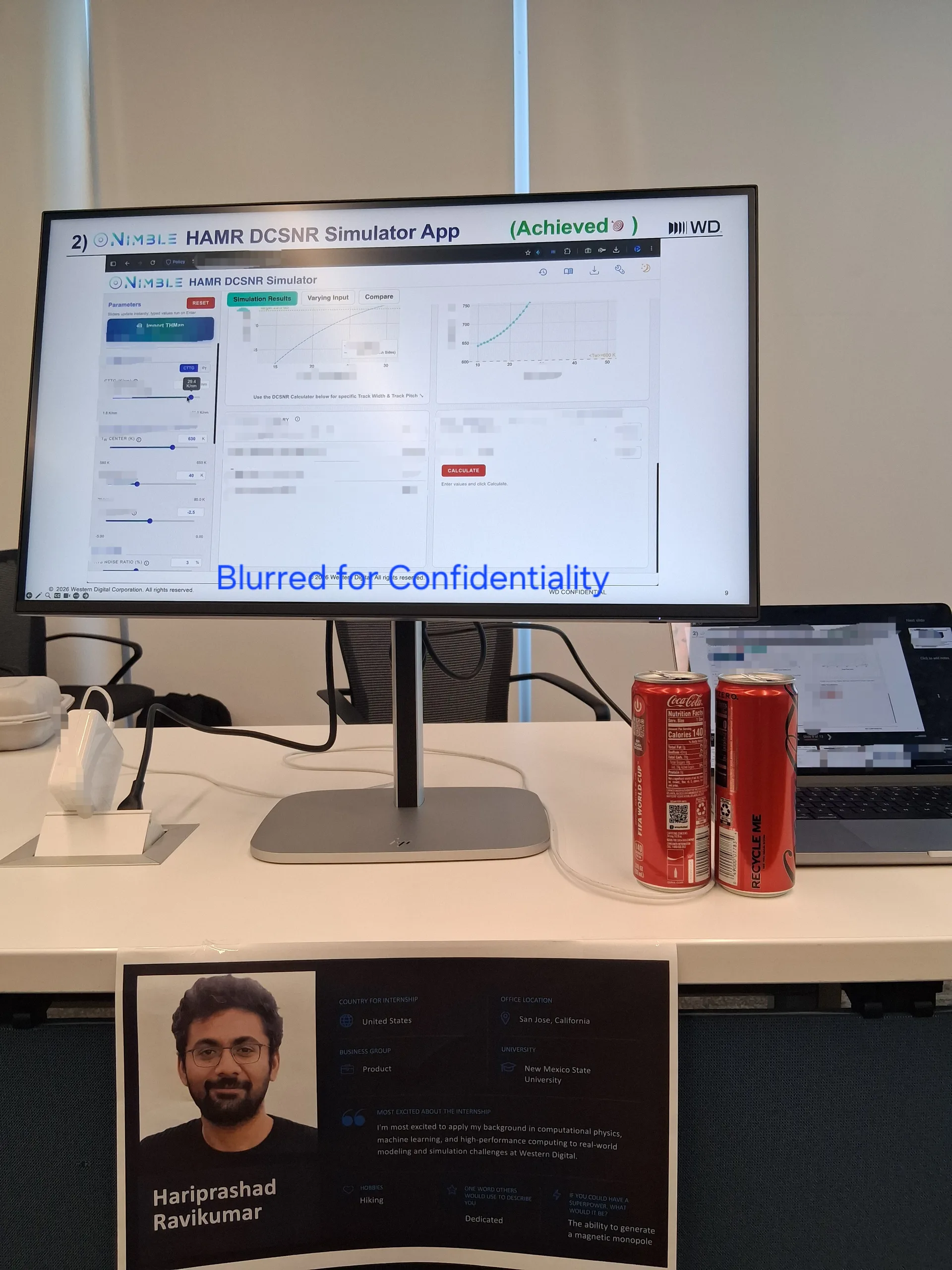
Intern – Media Test Engineering (HAMR Modeling & Simulation) @ Western Digital, San Jose, CA, USA
Production simulation platform for heat-assisted magnetic recording, used daily by 40+ senior R&D engineers and subject-matter experts across WD's US and Japan sites.
Peer-reviewed · Physical Review D
Interpolating conformal algebra in (1+1) dimensions between the instant form and the light-front form of relativistic dynamics.
Ji, C.-R. & Ravikumar, H. (2026). | Physical Review D 113, 096018. American Physical Society.

Tech stack
Languages
ML & Scientific
HPC & Parallel
Web & Visualization
DevOps
Currently interviewing for full-time roles.
Graduating December 2026. Looking for Research Scientist, Applied/ML Scientist, HPC & Scientific Computing Engineer, or Software Engineer roles in the SF Bay Area. Authorized to work in the U.S. under STEM OPT; open to H-1B sponsorship.