Cost-Aware Multi-Agent LLM Router
A router that sits in front of multiple LLMs of different price and quality tiers and decides, per prompt, which tier should answer it. Most traffic goes to a cheap model; only genuinely hard prompts pay for an expensive one. The pattern is well established (LMSYS RouteLLM[1], RouterBench[2], cascade-routing approaches like FrugalGPT[3], and the "adaptive model" approach used in products like Devin/Windsurf). The value here is engineering rigor and honest evaluation of a known pattern, not a new idea, including publishing an earlier version that didn't save money and explaining why.
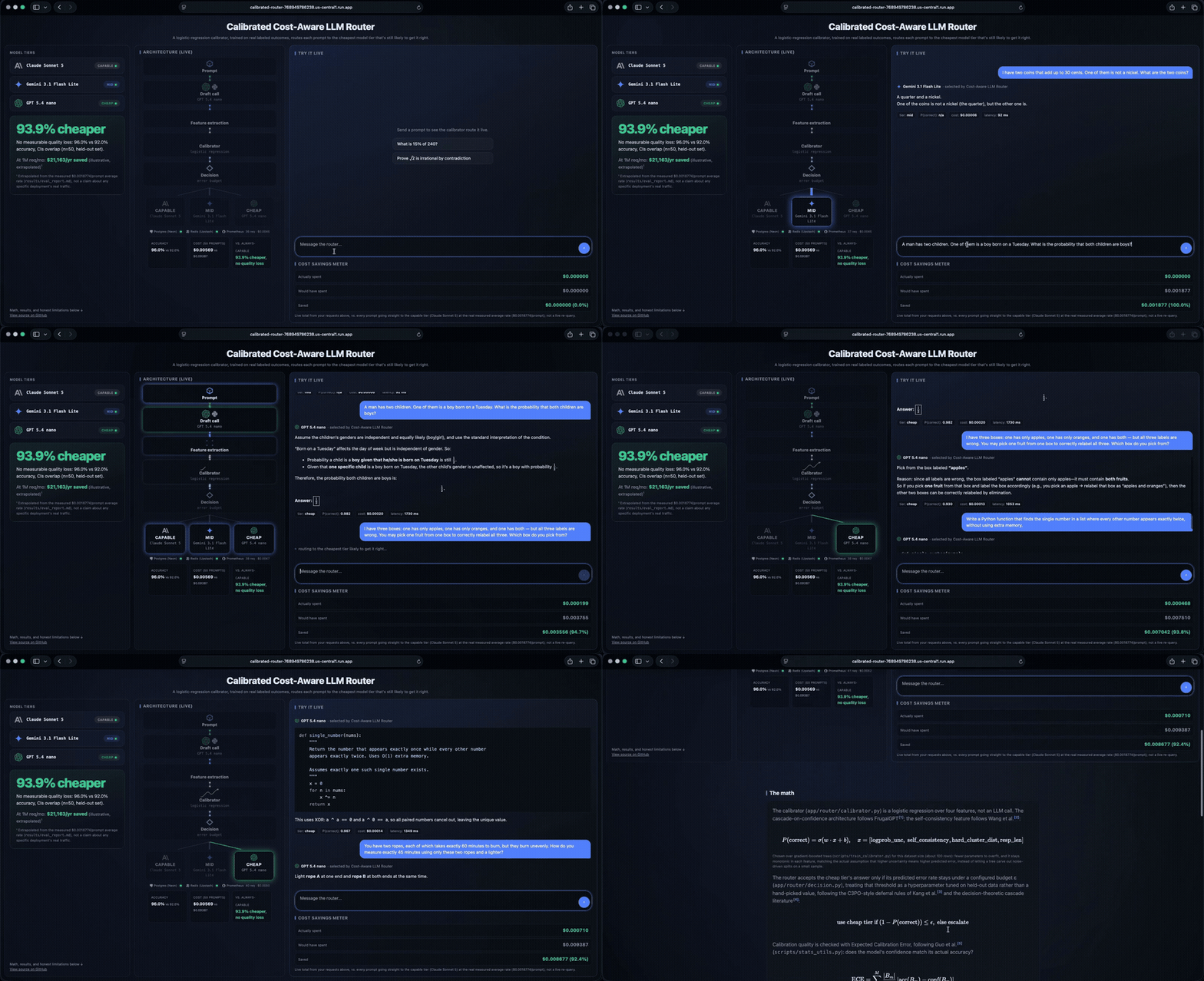
Live demo: a prompt routes to a tier in real time, with the architecture panel and cost-savings meter updating as it goes.
How it works
v2's pipeline, looping continuously here (not tied to a live request).
A small, calibrated statistics model handles the routing. It applies the same discipline as propagating measurement uncertainty in experimental physics to deciding whether a language model's answer can be trusted. This is a rebuild after an earlier prompted-classifier approach failed to save money (see "The obvious approach first," below). It is a real FastAPI service, not a no-code orchestrator, with Postgres logging every routing decision, Redis caching repeated prompts, and a hand-rolled async circuit breaker on every provider call.
For every prompt, a single draft call to the cheap tier produces four measurable features:
- Logprob uncertainty: A sigmoid on the negative mean token log-probability of the draft answer (neutral 0.5 if the provider doesn't expose logprobs).
- Self-consistency dispersion:
1 - majority_answer_count / num_samplesacross repeated higher-temperature samples[4], comparing extracted final answers (a regex-parsed number or multiple-choice letter), not raw response text. Otherwise, two step-by-step explanations reaching the same number look "inconsistent" purely from wording differences. - Hard-cluster distance: Cosine distance between the prompt's embedding (
sentence-transformers/all-MiniLM-L6-v2) and the centroid of a labeled set of known-hard prompts. - Response length: A cheap proxy correlated with question complexity.
A logistic regression, fit on real labeled outcomes (did the draft's answer actually match ground truth?), turns those four numbers into a calibrated probability:
where is the logistic (sigmoid) function, , squashing the linear score into a probability between 0 and 1.
The router accepts the cheap tier's answer only if its predicted error stays under a configured error budget , using a direct hypothesis-testing framing rather than a threshold pulled from a prompt:
If escalating past mid also exceeds budget (when a mid-tier score is available), it escalates once more to the capable tier, treating the top of the ladder as a trusted fallback rather than separately calibrated.
Calibration, not just accuracy
A router that is simply "accurate" isn't enough. A model that says "90% confident" should be right about 90% of the time it says that. The calibrator's confidence is checked for honesty, not just raw accuracy, using Expected Calibration Error[5] over confidence bins:
This is the actual differentiator versus a naive difficulty classifier: routing on a number that's been checked for honesty, not just a plausible-sounding LLM output. Training on 80 rows and validating on 20 held-out rows (from the same distribution, fit at training time) produced:
| Metric | Value |
|---|---|
| Validation accuracy (0.5 threshold) | 0.800 |
| Expected Calibration Error (5 bins) | 0.1671 |
| Brier score | 0.1521 |
That validation split is a sanity check, not the real generalization test. It's drawn from the same distribution the model fit on, just held out at fit time. The real test is a fully disjoint 50-prompt holdout set the calibrator never touched, covered in Results below.
The bug I caught
After the first full held-out evaluation, the calibrated router cost more than always calling the top-tier model directly across every error budget from 0.05 to 0.50. Sweeping the threshold didn't fix it, because the threshold wasn't the bug.
Checking config/pricing.json directly, rather than assuming the tier ladder was correctly ordered, showed why: the "mid" tier was Claude Haiku 4.5 at $1.00/$5.00 per 1M tokens, and the "capable" tier was Gemini 3.1 Flash-Lite at $0.25/$1.50. Mid was priced above capable. Every escalation to mid was strictly cost-dominated by just going straight to capable. No error-budget value could route around a ladder that was upside down. Swapping the assignments (Gemini to mid, Claude Sonnet 5 to capable, genuinely priced above Gemini) flipped the result completely.
Results
At the production default (ε = 0.15): 93.9% cheaper, no measurable quality loss. Held-out evaluation on 50 GSM8K[6]/MMLU[7] prompts from data/eval_holdout.jsonl, never seen during calibrator training, against always_capable (every prompt sent to Claude Sonnet 5 directly, $0.09387 total / $0.0018774 per prompt):
- Cost: $0.00569 vs. $0.09387, a 93.9% reduction.
- Escalation rate: 50.0% of prompts escalate past the cheap tier at ε=0.15. The other half are answered by the cheap tier alone. This is the number that determines how often the router actually pays for a pricier model.
- Accuracy: 96.0% (86.5-98.9% CI) vs. 92.0% (83.8-97.9% CI). The confidence intervals overlap, so this is not a statistically distinguishable difference at n = 50. That's parity, not a claimed improvement. A router that's simultaneously cheaper and more accurate than the model it routes to would be a free-lunch claim a 50-example sample can't support.
- At scale (illustrative, extrapolated from the real measured per-prompt rate, not a claim about any specific deployment's traffic): 1M requests/month would cost $113.80 with the router vs. $1,877.40 always-capable, saving $21,163/year.
Full 4-policy comparison on the same held-out set:
| Policy | Accuracy (95% CI) | Total cost (95% CI) | Avg latency |
|---|---|---|---|
| Calibrated router | 0.940 (0.838-0.979) | $0.00819 ($0.00647-$0.01007) | 1973 ms |
| Naive classifier (v1-style) | 0.840 (0.715-0.917) | $0.00626 ($0.00528-$0.00728) | 1796 ms |
| Always cheap | 0.840 (0.715-0.917) | $0.00490 ($0.00387-$0.00597) | 1067 ms |
| Always capable | 0.920 (0.812-0.968) | $0.09387 ($0.07199-$0.11680) | 2373 ms |
Sweeping the error budget from 0.05 to 0.50 shows accuracy peaking at ε = 0.10-0.20 (96.0%, 50-52% escalation rate) before falling off as the budget loosens past 0.30 (86.0%, 8-10% escalation rate). This was recomputed entirely from logged (calibrated P(correct), actual outcome) pairs, with zero additional API calls. The threshold itself is treated as a hyperparameter tuned on held-out data, following the cascade-routing deferral literature[8][9], rather than hand-picked.
Honest caveat: n = 50, and the confidence intervals are real and non-trivial. This is a genuine, reproducible result, not a fully settled one. A larger held-out set would tighten the claim.
The obvious approach first
Before landing on the calibrated router above, the obvious first attempt was simpler: just ask another LLM to rate the prompt's difficulty. That's what v1 did: an n8n workflow sent every prompt to a Groq-hosted classifier (openai/gpt-oss-20b, reasoning effort low), which rated it 1-5. A score of 3 or below routed to a cheap model (Groq openai/gpt-oss-120b), and 4 or above routed to a more capable one (Gemini 3.1 Flash-Lite).
Run against a 150-prompt evaluation set (75 GSM8K[6] + 75 MMLU[7]), the honest result was:
v1's real pipeline, looping continuously here on its actual measured split (not tied to a live request).
| Metric | Baseline (Capable Only) | Routed (Adaptive) |
|---|---|---|
| Total cost | $0.0241 | $0.0286 |
| Accuracy | 88.67% | 89.33% |
| Average latency | 3570.63 ms | 1805.55 ms |
| Capable model calls | 150 | 6 |
| Cheap model calls | 0 | 144 |
Cost went up, not down. The cheap model answered roughly 2.5x more verbosely than the capable one, and cost is tokens × price, not just the per-token rate. That single finding is why the router above exists: a routing system that only looks at per-token pricing can miss the actual cost driver completely, and no amount of tuning the same prompted-classifier approach would have fixed it. There was also a deeper problem with the difficulty score itself. A "3 out of 5" from an LLM is a plausible-sounding number with no calibration, no confidence interval, and no way to know if it is actually well-founded. The calibrated router's ECE/Brier checks (above) are built to catch exactly this.
Production hardening
Two bugs only showed up once this actually ran on Cloud Run, not in local testing: a 1Gi memory allocation that crashed under sentence-transformers' real footprint (fixed by bumping to 2Gi), and an embedding model that re-downloaded from HuggingFace on every cold start under Cloud Run's scale-to-zero behavior, hitting HuggingFace's rate limit and crashing the container before it finished starting (fixed by baking the model into the Docker image at build time).
A concurrency test (Locust, 8 concurrent users, 45 seconds, against the live /route endpoint) produced 86 requests with zero client-visible failures, and unplanned, triggered a real, organic circuit-breaker trip. Gemini's breaker was closed before the burst, tripped open immediately after (real transient provider failures under concurrency hit the 5-consecutive-failure threshold), and every one of the 86 requests still returned 200 OK via fallback to the capable tier. The breaker recovered to closed after the 30-second reset window, confirmed live against the running /metrics endpoint.
| Metric | Value |
|---|---|
| p50 latency | 2200 ms |
| p95 latency | 8200 ms |
| p99 latency | 11000 ms |
Try it
First request after a cold start takes roughly 40 seconds (container start, model load, real provider calls); warm requests run 2 to 3 seconds.
Stack
References
- LMSYS RouteLLM. github.com/lm-sys/RouteLLM.
- RouterBench. arXiv:2403.12031.
- Chen, L., Zaharia, M., & Zou, J. (2023). FrugalGPT: How to Use Large Language Models While Reducing Cost and Improving Performance. Stanford University. arXiv:2305.05176.
- Wang, X., et al. (2022). Self-Consistency Improves Chain of Thought Reasoning in Language Models. arXiv:2203.11171.
- Guo, C., Pleiss, G., Sun, Y., & Weinberger, K. Q. (2017). On Calibration of Modern Neural Networks. arXiv:1706.04599.
- Cobbe, K., et al. (2021). Training Verifiers to Solve Math Word Problems (GSM8K). arXiv:2110.14168.
- Hendrycks, D., et al. (2021). Measuring Massive Multitask Language Understanding (MMLU). arXiv:2009.03300.
- Pona, et al. Calibrate-Then-Delegate: Safety Monitoring with Risk and Budget Guarantees via Model Cascades. arXiv:2604.14251.
- Decision-theoretic cascade literature. arXiv:2605.06350.