Intern – Media Test Engineering(HAMR Modeling & Simulation)@ Western Digital, San Jose, CA, USA
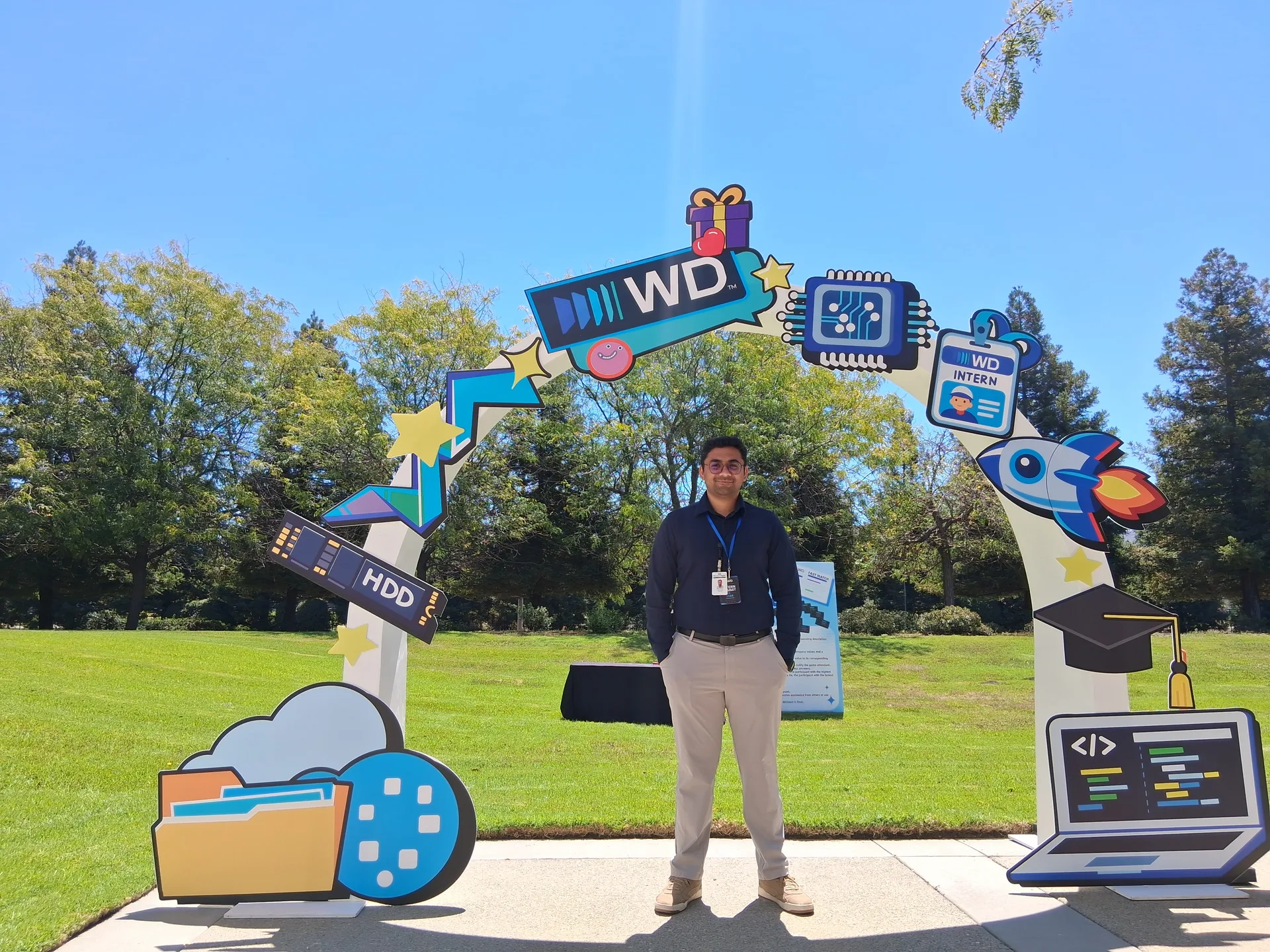
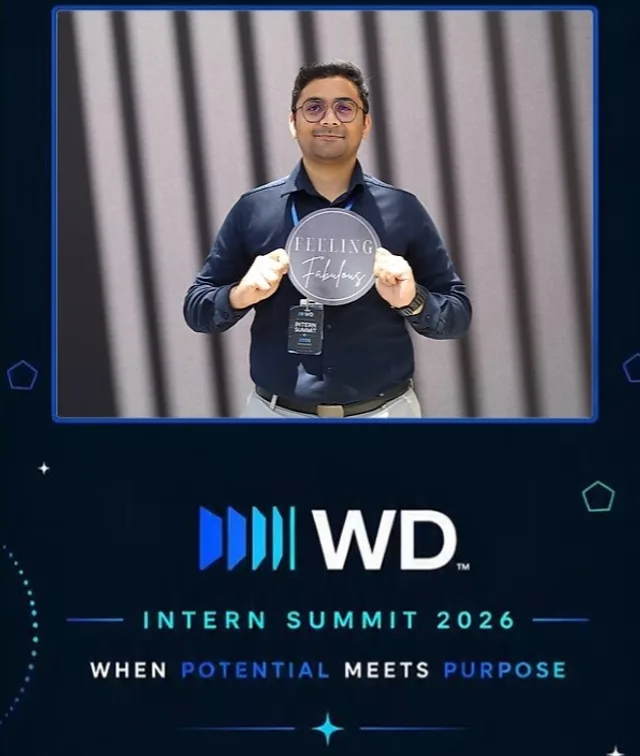
As part of this PhD internship in Heat-Assisted Magnetic Recording (HAMR) modeling:
- I developed analytical physics and statistical models to analyze thermally activated HAMR processes, directly supporting the R&D team.
- I collaborated with material scientists and test engineers to optimize the design and fabrication of next-generation magnetic recording media.
- I built thermal simulations and recording models to extract performance insights from spin-stand experiments.
- I designed statistical models to identify causal relationships in storage media performance metrics.
- I shipped a full-stack enterprise physics engine using Dash and Plotly. We packaged it as a modular Python library and deployed it on Kubernetes via Jenkins CI/CD. Over 40 senior R&D engineers and subject-matter experts across the US and Japan use it today.
This role sat at the intersection of data engineering, materials science, and physics.
Projects
During my internship at Western Digital, I delivered two HAMR projects of equal scope: an analytical physics model for multi-write erasure, and a full-stack enterprise simulation app that lets engineers calculate the signal-to-noise ratio of recording media using physics and statistical models.
1. Physics Modeling
The team needed to understand write behavior across multiple write cycles to reduce adjacent track erasure (ATI and xTI) in high-density storage, avoiding the cost and latency of purely hardware-based experiments.
I derived a closed-form analytical model of grain magnetization dynamics from first principles to connect recording media properties to write behavior. Building on Néel-Arrhenius thermal switching and the Stoner-Wohlfarth model, I formulated expressions for switching time, noise power, and the probability of switching across multiple write cycles. I validated the model against Monte Carlo stochastic simulations and experimental spin-stand data on highly complex magnetic grain ensembles.
Result:
- Engineers can now predict and reduce erasure computationally.
- We are preparing the core models and research findings for a peer-reviewed publication.
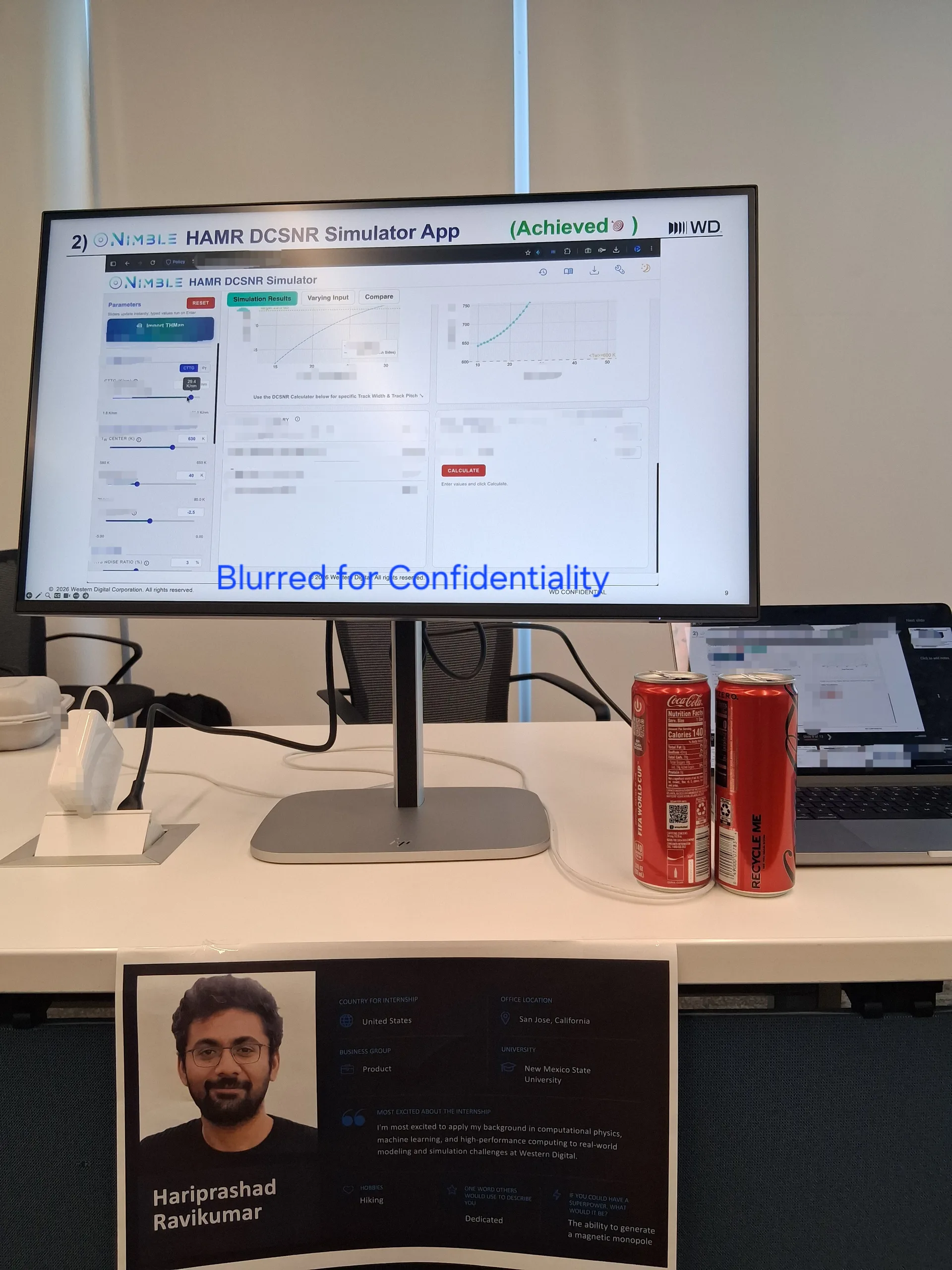
2. Physics Simulation App
The engineering team needed a way to evaluate recording performance and signal-to-noise ratios directly from material parameters.
I built and deployed a full-stack enterprise physics simulator using Dash. A modular Python physics and statistical library backs the frontend, calculating these metrics in parallel.
Engineers use the tool to run real-time parameter sweeps, compare simulation runs side by side, and export results automatically as PowerPoint or Excel reports. We packaged the app as a PyPI-installable Python library with a clean API, integrating it into a broader internal platform alongside other Dash and Plotly tools.
The application accelerates development cycles by removing a hardware-experiment step from the loop, reducing overall testing costs.
System architecture, input to output
How it works
- Input. Engineers enter parameters manually, upload a file, or receive a JSON payload handed off from the broader enterprise platform.
- Client-side. The payload lands in IndexedDB; the Dash frontend reads it and a statistical/physics fitting engine auto-populates the parameter UI.
- Backend. The analytical HAMR switching model runs, with a parallel worker pool computing sweeps simultaneously.
- Results. Plotly renders DC-SNR and other recording metrics interactively.
- Export. Results package into multi-format reports for planning the next test experiment.
Deployed on Kubernetes with Jenkins CI/CD for reliable, reproducible builds.
Talks & Presentations
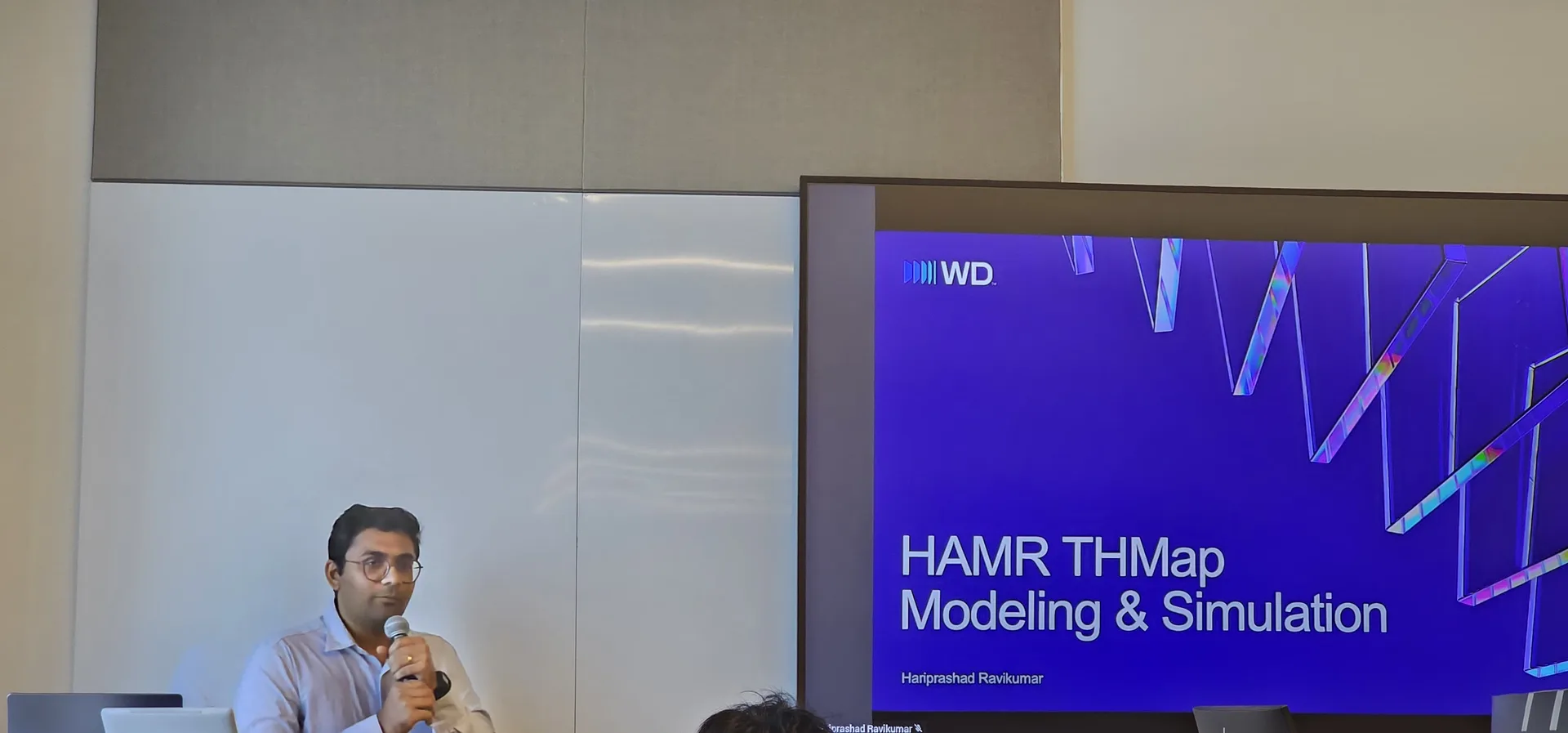
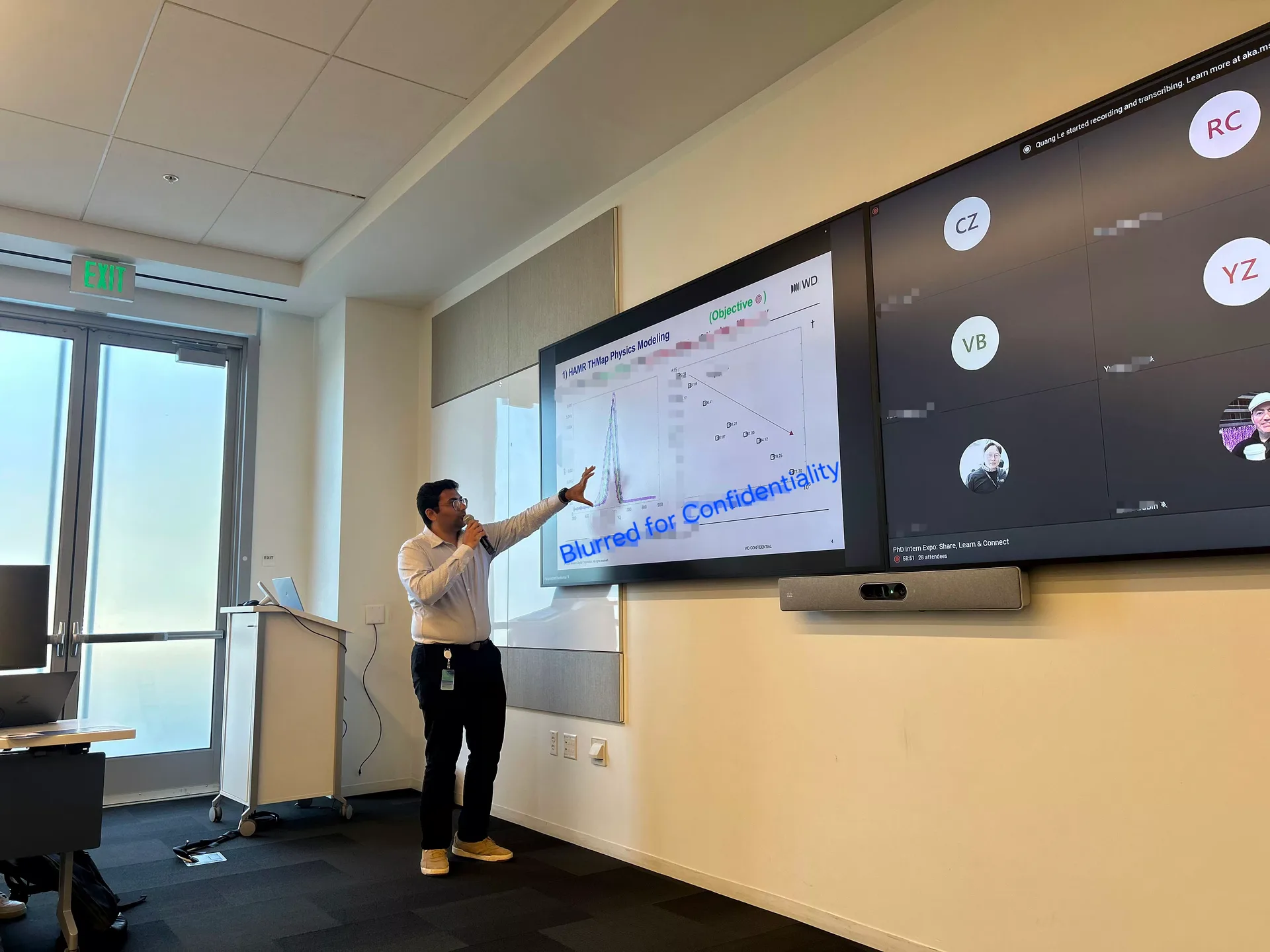
I shared key results with the broader team and presented my simulation research at the PhD Expo.
- PhD Expo 2026 (Aug 2026): "HAMR Modeling & Simulation: The DC-SNR Simulator," to 50+ senior technologists, subject matter experts, and PhD interns
- Internal Engineering Review (Aug 2026): "DC-SNR Physics Simulator App and Multiple-Write HAMR Analysis," to 30+ sputtering engineers, material scientists, test engineers, and R&D engineers
- Internal Engineering Review (Aug 2026): "Multiple-Write HAMR Analysis and Thermally Activated Switching Processes," to 30+ R&D engineers and technologists
- Internal Engineering Review (July 2026): "Analytical Model for Log-Linearity of Write Temperature with Number of Writes," to 30+ R&D engineers and technologists
- Internal Engineering Review (July 2026): "HAMR DC-SNR Physics Simulator App," to 30+ material scientists, test engineers, and subject matter experts
- Cross-Site Engineering Review, WD Japan (July 2026): "Analytical Model for Log-Linearity of Write Temperature with Number of Writes," to 30+ R&D engineers and technologists
Impact
Over 40 senior R&D engineers and subject-matter experts from the sputtering team, the media team, and R&D technologists across Western Digital sites in the United States and Japan use the simulation app in daily production.
Hackathon
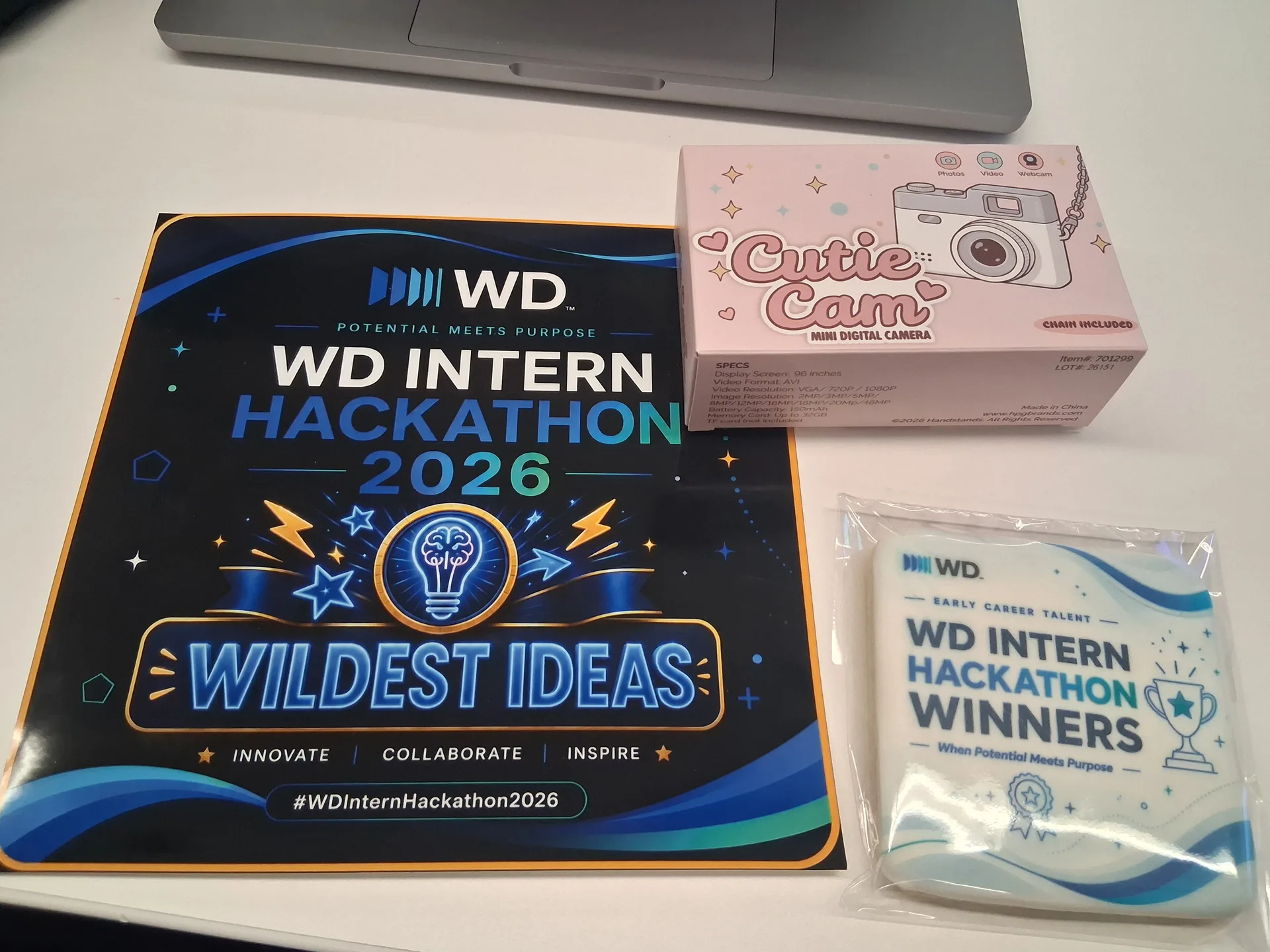
At the WD Intern Summit 2026 Hackathon in San Jose, our team won the "Wildest Idea" award. We built a fully working, scalable 3D browser-based game from scratch in just a few hours.
WD Aquarius is a first-person robotic shark exploration game that runs entirely in the browser. We built it using:
- Three.js / WebGL for real-time 3D rendering
- Simplex Noise for procedural terrain and ocean generation
- Pointer Lock API for physics-based first-person swim controls with velocity and drag simulation
- Web Audio API for an immersive underwater soundscape
- HTML / CSS / JavaScript / TypeScript for a custom sci-fi HUD featuring live telemetry, sonar, and depth tracking
- Vite for bundling and the local development server
We chose not to use engines like Unity or Unreal, proving that the ambitious scope was possible with native web technologies.
Acknowledgements
The internship exceeded my expectations. I left having built tools actively used by the team, contributed to R&D, and prepared a publication.
I am grateful to my managers and mentors, Richard Brockie and Pierre-Olivier Jubert. They scoped my project clearly from day one, provided the resources I needed, and included me in staff meetings and weekly HAMR physics team discussions. They supported and challenged me, making me feel like a full-time engineer. Thank you both.
Stack
Python · Dash · Plotly · IndexedDB · Kubernetes · Jenkins · NumPy/SciPy · Monte Carlo validation · Three.js (Hackathon)